Choose the Position First
The mount decides what your footage looks like. The common options each have a trade-off:
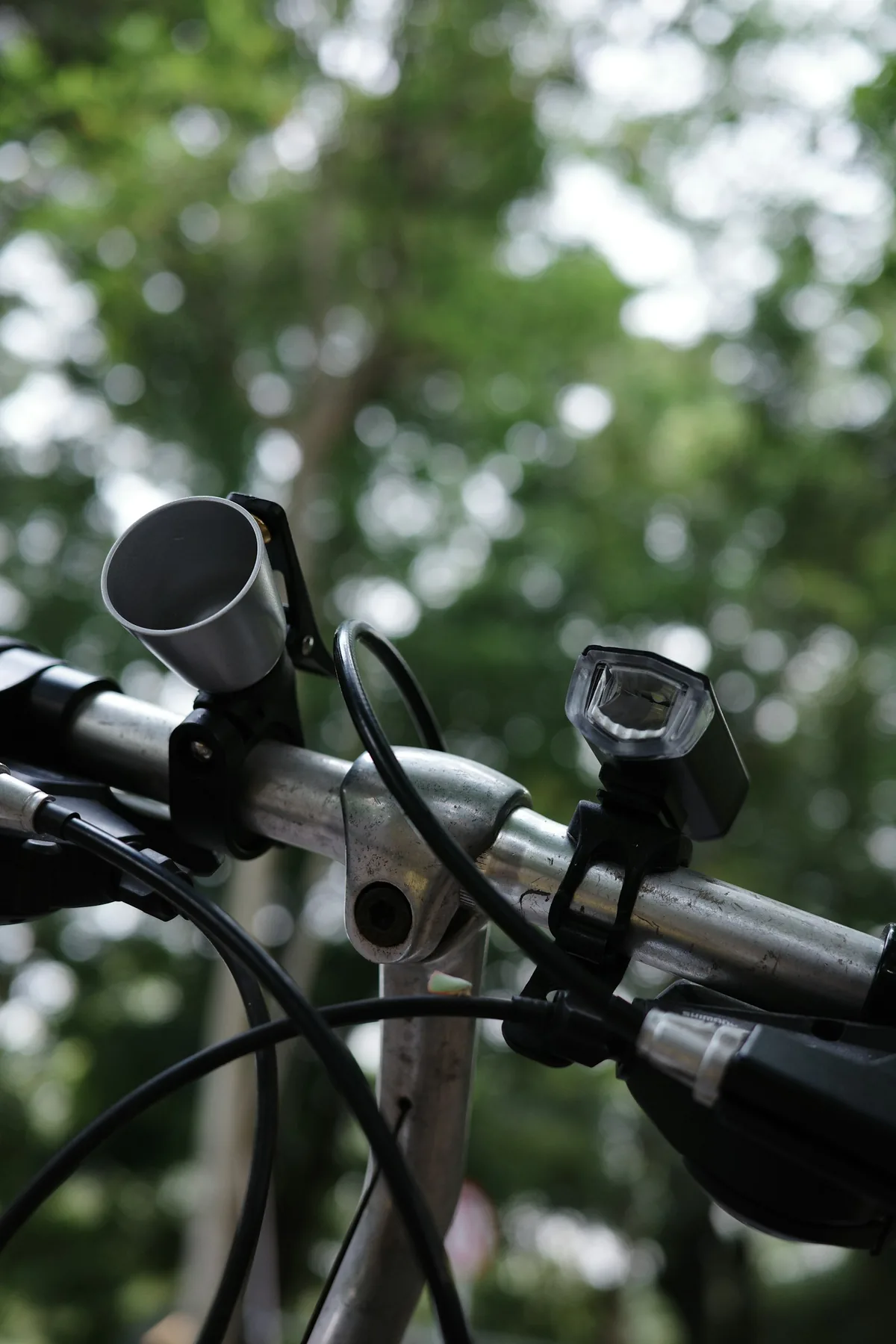
- Handlebar or stem – A steady view of the road ahead that shows your hands and the front wheel. Vibration from the handlebar can be a problem on rough surfaces.
- Chest – A body-height view that is steadier than the head and keeps the camera off your helmet.
- Helmet top or front – Follows where you look, which feels natural but moves with every head turn.
- Seat post or rear rack – Useful for a rear view of traffic.
Test the framing by recording a short clip and checking the horizon, your own handlebars and any parts of the bike that get in the way, before you commit to a full ride.
Fitting It to a Bike
Most action cameras fit a standard clamp or adhesive mount that goes round a handlebar or frame tube. Tighten it so it cannot twist during a bump, and add a safety tether if the camera or the mount allows one. Keep the camera, its mount and any cable clear of brake levers and gear controls, and make sure nothing blocks your lights or reflectors. The Highway Code's rules for cyclists say your bike needs a white front light and a red rear light at night, so do not let a camera or its mount cover them.
Check the mount after your first few minutes and again after any rough patch. Screws and clamps can loosen with vibration, and a camera that drops while you ride can become a hazard to you or to the next person on the road.
Fitting It to a Helmet: The Safety Question
Helmets are designed and approved as a complete product. Many cycling helmet makers sell breakaway camera mounts designed to separate on impact, and some helmets come with a mount built in. Check the helmet's instructions, because the maker may say what is and is not allowed.
Do not drill, cut or glue into the shell or liner, and avoid mounts that clamp through vents unless the helmet maker says that is acceptable. Research has looked at the question, though not for every helmet type. A report by TRL for the BBC tested cameras on climbing helmets and found that no tested combination exceeded the injury thresholds it used, but it also found that some impacts increased rotational head velocity, and it recommended further testing of other products. Because the testing was on climbing helmets, it should not be taken as proof for a motorcycle helmet.
The UK government's SHARP scheme says it tests helmets as sold and does not test accessories fitted afterwards, so a SHARP rating does not cover a camera you add yourself. If you want to be careful, mount the camera elsewhere, such as the chest or handlebar.
UK Rules for Motorcyclists
On UK roads, motorcyclists must wear a helmet that meets one of the standards listed on GOV.UK: BS 6658:1985 with the BSI Kitemark, UNECE Regulation 22.05 or 22.06, or an equivalent EEA standard with an equivalent mark. GOV.UK does not give separate rules about action cameras, so the practical question is whether the helmet still behaves as the approved product once the camera is fitted. The helmet maker is the best person to answer that.
Your insurer may also have a view if you are in a crash and a modified helmet becomes part of the claim. It is sensible to read your policy, or ask, before you attach anything to the shell.
Also think about what the camera does to your concentration. Rule 148 of the Highway Code says safe driving and riding needs concentration, so set the camera up before you leave and do not adjust it on the move.
Cycling Helmets and the Highway Code
The Highway Code's rule 59 says cyclists should wear a helmet that meets current regulations, fits and is securely fastened. If you add a camera, follow the same principle as above: use the maker's breakaway mount rather than adhesive or tape that could change how the helmet behaves, and keep the chin strap and fit exactly as they were.
Filming in Public
Pointing a camera at the road for your own records is common. If you publish footage online, other people's faces and number plates can be personal data. The Information Commissioner's Office says, in its home CCTV guidance, that images and voices of other people count as their personal information. That guidance is about home cameras rather than action cameras, so if you plan to publish footage beyond personal use, check the ICO's current advice and think about blurring faces and plates.
Many riders and drivers also use a camera as evidence after an incident. For a fixed camera on a car, see our guide on how dash cams work, which covers loop recording and event locks that an action camera may not offer by default.
Practical Tips
- Start the recording before you set off and check the camera is not warning of a full card or a low battery.
- Use a high enough frame rate and stabilisation mode for the surface you ride on.
- Keep a spare mount and a few cable ties or a tether in your bag.
- Check the mount, the screws and the helmet after every crash or drop, even a small one.
The Short Version
The simplest mounting position is often the one that does not touch your helmet. If you do mount on a helmet, use the manufacturer's breakaway option where there is one, do not modify the shell, and confirm what the helmet maker says about accessories. Make sure the camera never covers lights or gets in the way of controls.
We may earn a commission when you buy through links on our site. Learn more · How we rank products