Start With the Room, Not the Product
Most guides that compare the two, including one from Expert Reviews, come back to the same few points: room light, black levels, picture size, sound, ease of set-up and how long the light source lasts. In a small room, one more matters: how far you sit from the picture.
Room Light
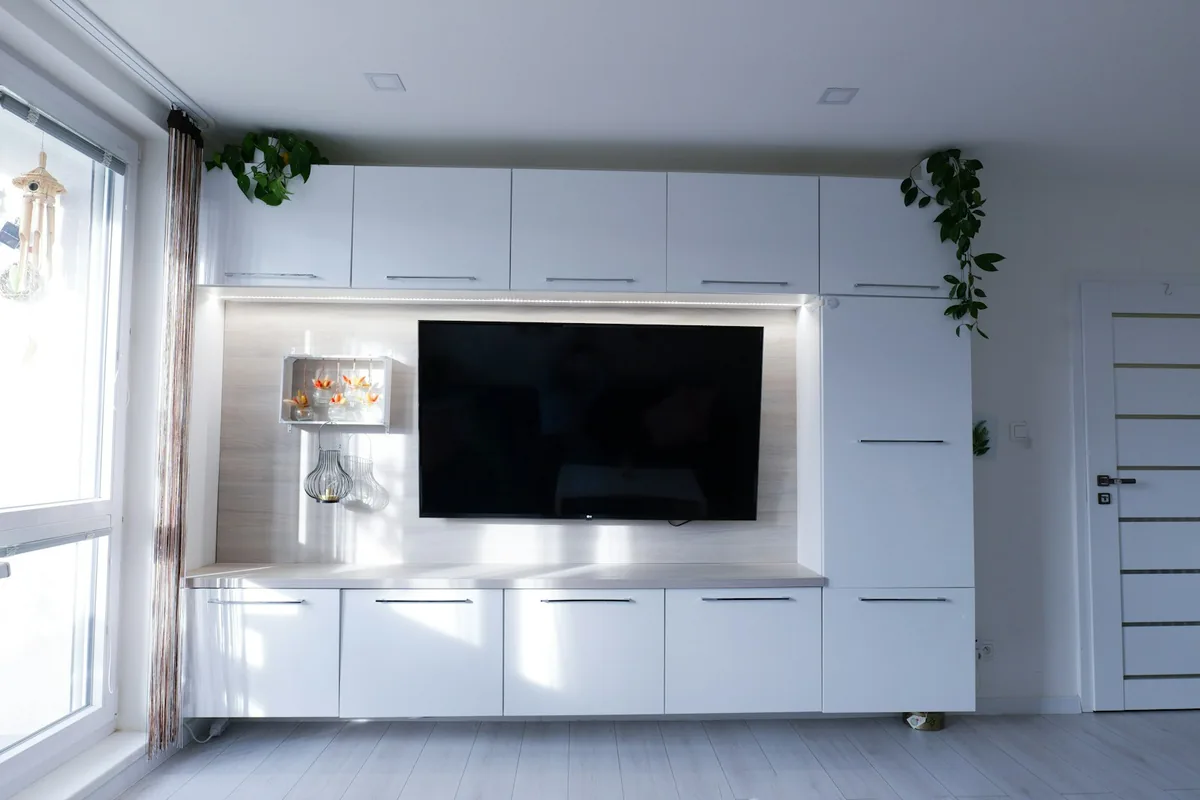
This is usually the biggest difference. Expert Reviews says projectors historically needed near-dark rooms. Newer bright LED and laser models cope better with daylight, but ambient light is still a problem. TVs are generally watchable in daylight, although reflections can be an issue near windows. If your room has big windows and no curtains or blinds, a TV is the lower-risk choice. If you can darken the room at the times you watch, a projector becomes realistic.
Black Levels and Picture Quality
A projector works by shining light onto a surface, and Expert Reviews notes that really dark, inky blacks are harder for it to recreate. Top TVs can reach black levels of zero or close to it. If you mostly watch dark films in a bright-ish room, that gap shows. If you watch in the evening with the lights low, it matters less, because the room itself is dark.
Picture Size and Viewing Distance
Size is where projectors pull ahead. Expert Reviews says entry-level projectors can deliver 100 to 150 inches, while the biggest TVs become very expensive. But a huge picture is not always better in a small room. Kaleidescape gives two rules of thumb: multiply your viewing distance in inches by 0.65 for a mixed-use room, or by 0.835 for an immersive, cinema-style view, to get a diagonal size. At a 6-foot (72-inch) seat distance, that works out at roughly 47 to 60 inches. At 8 feet (96 inches) it is about 62 to 80 inches.
In many small rooms, that is well within the range of a large TV. A projector's extra size only pays off if you sit far enough back to take in the whole screen, and the picture has somewhere to go.
Where the Projector Has to Go
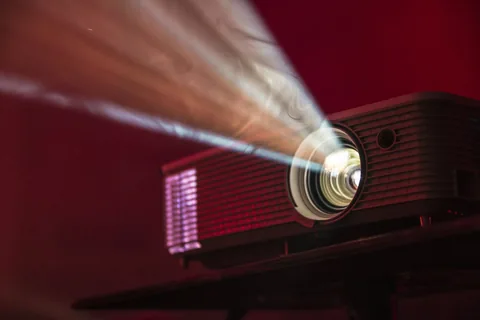
A projector also needs space. A standard model's throw distance is set by its lens and, for a 100-inch image, can run to several metres; see how to set up a projector at home for the sums. Short-throw models suit smaller rooms, according to Expert Reviews, and BenQ's examples show an ultra-short-throw model placing a 100-inch image from under 3.3 feet (1 metre) away. You also need a suitable wall or a screen, which is an extra item a TV does not require.
Features at the Budget End
Expert Reviews says entry-level projectors cost about the same as budget TVs, but a projector also needs a screen or a suitable wall. At the budget end it finds that few projectors offer 4K or HDR, while budget TVs offer more for the money, including 4K, a brighter picture and some HDR. HDR is a particular weak point for projectors, because it relies on bright highlights and deep blacks, the two things a projector finds hardest in a lit room. If these features matter to you, check the specification of any projector against a TV at the same level before deciding.
Our guide to projector brightness and resolution explains how to read those spec sheets, including the difference between native and pixel-shifted 4K.
Sound
Expert Reviews says built-in projector speakers have often been weak, and that portable models sound best placed directly in front of the viewer. Premium TVs have strong built-in audio, though cheaper ones often have basic sound. Either way, a soundbar helps, but a projector is the more likely to need one.
Set-Up and Everyday Use
A TV usually just works: put it on a stand or the wall and plug it in. A projector's picture depends on focus, alignment, the screen and room lighting. Pull-up and roll-down screens and short-throw models make it easier, but you will need to set it up with more care.
How Long They Last
Expert Reviews says lamp-based projectors needed a new lamp every 4,000 to 8,000 hours, while modern LED and laser models last about 20,000 to 30,000 hours. It puts modern OLED, LCD and mini-LED TVs at around 36,000 to 100,000 hours, or roughly 10 to 30 years at 10 hours a day. Check which light source a projector uses before you buy, since a replacement lamp is an ongoing cost.
A Simple Way to Decide
- Choose a TV if the room is bright in the daytime, you watch in the day, you want the best blacks or you want something that works without fuss.
- Choose a projector if you can control the light, want a picture larger than a TV allows from your seat, or want a set-up you can fold away.
- Check the numbers either way – work out the picture size from where you sit, and read about projector brightness before you rely on a lumens figure.
We may earn a commission when you buy through links on our site. Learn more · How we rank products